
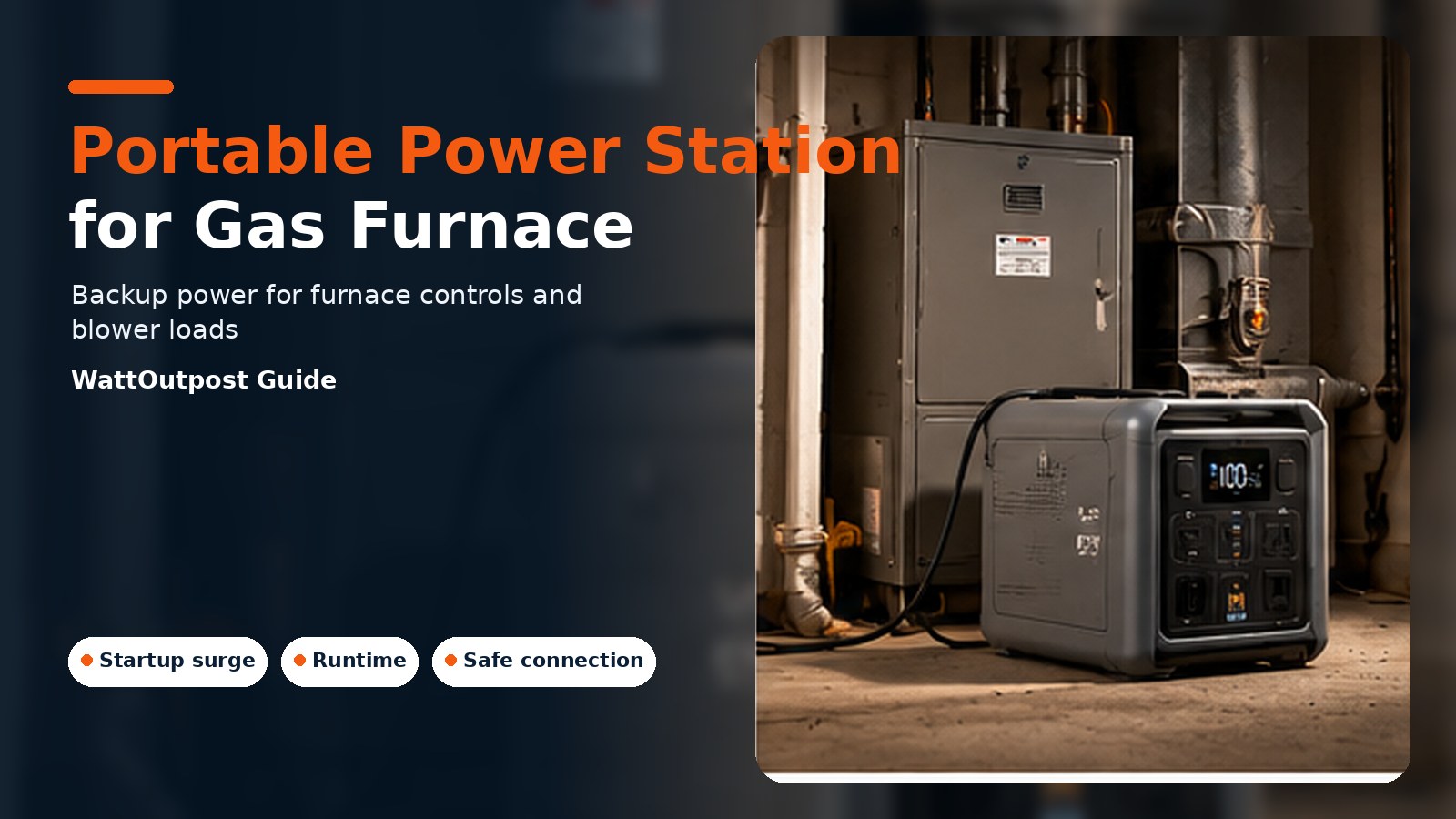
As an Amazon Associate I earn from qualifying purchases.
A gas furnace burns natural gas or propane for heat, but it still depends on electricity for the blower, inducer, ignition system, control board and safety controls. During a power outage, a properly sized portable power station can support many compatible 120V forced-air gas furnaces, but the right size depends on your furnace’s actual electrical demand and how it is connected.
Last updated October 9, 2026. Specifications come from manufacturers, and we do not present them as hands-on testing. See our editorial and research methodology.
This guide compares five current portable power stations for furnace-backup planning. It focuses on continuous AC output, battery capacity, published surge headroom, portability and connection compatibility rather than assuming one battery will work with every furnace.
Quick answer: what size power station does a gas furnace need?
Start with the furnace, not the battery catalog. Check the electrical nameplate and manual, and ideally have the running and startup demand measured. The power station’s continuous AC output must comfortably cover the running load, while its short-duration starting capability must handle the blower and other startup demand.
For many modest residential furnaces, a roughly 1kWh station with 1,500W to 1,800W of continuous pure-sine-wave output can be a useful starting class. A 2kWh-class battery gives more stored energy for longer outages. Those are shopping categories, not universal sizing rules: older blower motors, larger furnaces and additional loads can require more output.
Connection safety matters as much as battery size
Many central furnaces are hardwired rather than fitted with a normal appliance plug. A portable power station should not be connected to a household receptacle to energize the furnace or home wiring. Improper backfeeding can energize circuits unexpectedly and endanger utility workers.
If the furnace is hardwired, have a qualified electrician determine an approved transfer, inlet or other listed connection method that is appropriate for the furnace, the power station and local electrical requirements. Do not improvise a male-to-male cord or other backfeed arrangement.
Neutral and grounding compatibility
Furnace controls can also be sensitive to how neutral and grounding are handled. Portable power stations differ in their AC-output configuration, and some furnaces may not operate correctly even when the inverter has enough wattage. If the furnace fails to ignite, shuts down unexpectedly or reports a fault when connected to backup power, do not improvise a grounding or bonding adapter. Have the exact furnace and power station checked by the manufacturer, an HVAC technician or a qualified electrician.
Five portable power stations to compare for furnace backup
Jackery Explorer 2000 v2
higher output headroom plus 2kWh-class energy
Capacity
2,042Wh
Continuous AC output
2,200W
Published surge / peak
4,400W surge peak
Weight
39.5 lb
Anker SOLIX S2000
longer runtime when a measured furnace fits the 1,500W limit
Capacity
2,010Wh
Continuous AC output
1,500W
Published surge / peak
verify exact startup compatibility
Weight
35.7 lb
BLUETTI Elite 100 V2
lighter 1kWh option with strong published surge headroom
Capacity
1,024Wh
Continuous AC output
1,800W
Published surge / peak
3,600W surge
Weight
about 25.3 lb
Anker SOLIX C1000 Gen 2
higher-output 1kWh backup candidate
Capacity
1,024Wh
Continuous AC output
2,000W
Published surge / peak
3,000W peak
Weight
24.9 lb
Jackery Explorer 1000 v2
lighter 1kWh option when the furnace fits its output envelope
Capacity
1,070Wh
Continuous AC output
1,500W
Published surge / peak
3,000W surge peak
Weight
23.8 lb
View the full specification table
| Product | Capacity | Continuous AC output | Published surge / peak | Weight | Best fit in this guide |
|---|---|---|---|---|---|
| Jackery Explorer 2000 v2 | 2,042Wh | 2,200W | 4,400W surge peak | 39.5 lb | higher output headroom plus 2kWh-class energy |
| Anker SOLIX S2000 | 2,010Wh | 1,500W | verify exact startup compatibility | 35.7 lb | longer runtime when a measured furnace fits the 1,500W limit |
| BLUETTI Elite 100 V2 | 1,024Wh | 1,800W | 3,600W surge | about 25.3 lb | lighter 1kWh option with strong published surge headroom |
| Anker SOLIX C1000 Gen 2 | 1,024Wh | 2,000W | 3,000W peak | 24.9 lb | higher-output 1kWh backup candidate |
| Jackery Explorer 1000 v2 | 1,070Wh | 1,500W | 3,000W surge peak | 23.8 lb | lighter 1kWh option when the furnace fits its output envelope |
Important: surge ratings and manufacturer-specific boost modes are not interchangeable. Use the ordinary continuous AC rating as the baseline, then confirm that the exact power station can support your furnace’s measured startup behavior.
Why a gas furnace still needs electricity
The gas flame provides the heat, but a modern forced-air furnace is an electrical appliance as well. The blower moves heated air through the ducts, an inducer may establish draft, the ignition system starts combustion, and the control board and safety circuits supervise operation.
Blower demand can vary substantially with motor type, fan speed and duct conditions. The U.S. Department of Energy’s Building America Solution Center notes that ECM air-handler fans operate differently from older PSC motors and can use much less power at lower speeds. That is one reason generic online furnace-wattage figures should not replace the electrical information for your own system.
How to size a portable power station for your furnace
1. Identify the furnace’s electrical supply
Confirm whether the furnace is a typical 120V forced-air gas furnace and whether it is cord-and-plug connected or hardwired. Do not size from the furnace’s BTU heating rating; BTUs describe heat output, not electrical demand.
2. Find the actual running and startup demand
Use the furnace nameplate and manufacturer documentation as the starting point. If the information is unclear, an HVAC technician or qualified electrician can measure the electrical demand through a normal heating cycle. This is more reliable than assuming every furnace blower uses the same wattage.
3. Leave output headroom
The station’s continuous inverter rating must exceed the sustained furnace load with reasonable margin. Startup demand can be higher, especially with some blower motors, so the station also needs enough short-duration capability for the furnace to start without tripping its inverter.
4. Choose battery capacity for the outage you are planning for
Capacity in watt-hours determines how much energy is stored. A 2,000Wh-class battery can theoretically provide about twice the energy of a 1,000Wh-class battery at the same average load, but real runtime is lower than simple nameplate arithmetic because of inverter losses, battery reserve, temperature and the furnace’s cycling behavior.
A simple furnace-runtime planning method
Use this as a planning framework rather than a runtime promise:
- Measure or verify the furnace’s electrical draw while it is actually heating.
- Estimate how much of each hour the furnace is likely to run during the outage.
- Multiply running watts by that duty cycle to estimate average electrical demand.
- Divide the battery’s watt-hour capacity by that average demand, then reduce the result to allow for conversion losses and reserve.
For example, if a measured furnace draws 500W while heating and runs about half the time, its simple average is 250W. A 1,024Wh battery divided by 250W gives a theoretical upper bound of about 4.1 hours before losses; a 2,042Wh battery gives about 8.2 hours before losses. Actual runtime will be lower and can change significantly with weather, thermostat settings, blower speed and battery conditions.
Jackery Explorer 2000 v2: more output headroom and stored energy
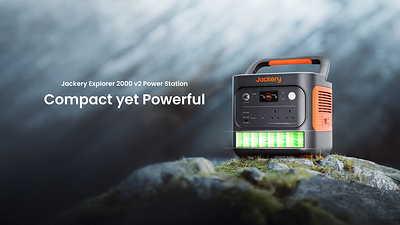
Jackery lists the Explorer 2000 v2 at 2,042Wh with 2,200W rated AC output and a 4,400W surge peak. It weighs about 39.5 lb. Among the models in this guide, it combines the largest continuous-output rating with 2kWh-class capacity.
That makes it the most straightforward candidate here when you want both more inverter headroom and more stored energy. The tradeoff is size and weight, and its specification still does not guarantee compatibility with an unmeasured furnace.
Anker SOLIX S2000: 2kWh capacity with a lower continuous-output ceiling
Anker lists the SOLIX S2000 at 2,010Wh and 1,500W AC output, with up to 400W solar input and a weight of about 35.7 lb. The attraction here is 2kWh-class stored energy in a lighter chassis than the Explorer 2000 v2.
The tradeoff is the 1,500W continuous-output ceiling. This is a runtime-oriented choice only when your measured furnace startup and running demand fit comfortably within the station’s supported output.
BLUETTI Elite 100 V2: lighter 1kWh backup with strong published surge headroom
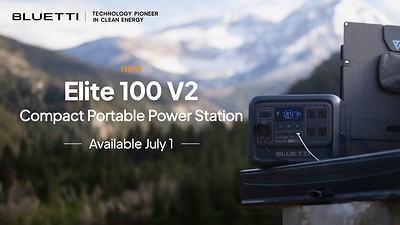
BLUETTI lists the Elite 100 V2 at 1,024Wh and 1,800W continuous AC output, with a manufacturer-listed 3,600W surge. The US specification lists a weight of about 25.3 lb and up to 1,000W solar input.
This combination is useful when you want more output headroom than a 1,500W station without moving into a 2kWh chassis. Its 1kWh battery still means less runtime than the two larger batteries above at the same average furnace load.
Anker SOLIX C1000 Gen 2: higher-output 1kWh backup
Anker lists the C1000 Gen 2 at 1,024Wh with 2,000W continuous AC output and a 3,000W peak. It weighs 24.9 lb and supports up to 600W solar input.
For a furnace whose measured running and startup demand fit that output envelope, the Gen 2 offers more ordinary inverter headroom than the original C1000 while remaining in a carryable ~1kWh class. Anker also lists a 10ms UPS switchover.
Jackery Explorer 1000 v2: the lighter 1kWh option
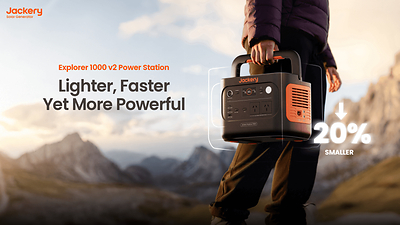
Jackery lists the Explorer 1000 v2 at 1,070Wh, 1,500W rated AC output and a 3,000W surge peak, at about 23.8 lb. It is the lightest 1kWh-class station in this five-model comparison.
Its main tradeoff is the lower 1,500W continuous rating. It can be attractive when easier handling matters and your furnace has already been verified to fit comfortably within that output limit.
What to prioritize when choosing
- Verified output compatibility: measured running and startup demand come first.
- Battery capacity: choose enough watt-hours for the outage duration you are planning for.
- Pure-sine-wave AC output: use the manufacturer’s ordinary inverter rating as the comparison baseline.
- Recharge strategy: consider how quickly the battery can recover when grid power briefly returns or when compatible solar is available.
- Weight: a station that stays beside the furnace can justify more capacity than one you expect to move frequently.
- Approved connection: hardwired equipment needs a safe, code-appropriate way to receive backup power.
For broader outage planning that includes refrigerators, routers, lights and other essentials, see our portable power stations for home backup guide. For the crowded 1kWh shopping class, see 1,000W portable power stations.
FAQ
Can a portable power station run a gas furnace?
Yes, many compatible gas furnaces can run from a properly sized portable power station. The station must support the furnace’s continuous and startup electrical demand, and the connection and neutral/grounding arrangement must be appropriate for the furnace.
Will gas heat work when the power is out?
Not normally. Even though the heat comes from gas, a modern forced-air furnace still needs electricity for its blower, controls, ignition and safety systems.
How many watts does a gas furnace use?
There is no single reliable number for every furnace. Electrical demand varies with blower motor type, airflow, furnace size, operating stage and other components. Check the nameplate/manual or have the system measured rather than sizing a backup battery from a generic wattage estimate.
Can a 1,000W power station run a furnace?
Possibly, but the phrase “1,000W power station” is ambiguous. It may refer to inverter output or roughly 1,000Wh of battery capacity. A furnace needs both adequate continuous output and enough startup capability; battery watt-hours then determine runtime.
How long will a 1,000Wh battery run a gas furnace?
It depends on the furnace’s measured electrical draw and how often it cycles. Use average electrical demand over time, then allow for inverter losses and battery reserve. Avoid treating the battery’s nameplate watt-hours as fully usable AC energy.
Can I plug my hardwired furnace directly into a power station?
Not without an approved connection method. A qualified electrician should determine how a hardwired furnace can safely receive backup power. Never backfeed household wiring by connecting a portable source to an ordinary wall receptacle.
Choose for your furnace
A portable power station can be a practical way to keep a compatible gas furnace operating during an outage, but furnace backup is not just a battery-capacity problem. Confirm the electrical load, startup behavior, connection method and neutral/grounding compatibility first.
Among the five options here, the Jackery Explorer 2000 v2 provides the most continuous-output headroom and more stored energy, while the Anker SOLIX C1000 Gen 2 provides 2,000W output in a lighter 1kWh class and the BLUETTI Elite 100 V2 provides 1,800W. The Anker SOLIX S2000 prioritizes 2kWh capacity with a lower 1,500W ceiling, and the Jackery Explorer 1000 v2 is the lightest 1kWh option here. The right choice is the one that matches your measured furnace rather than the one with the largest marketing number.
Related guides: portable power stations for home backup, portable power stations for refrigerator backup, 1,000W portable power stations, and our best portable power stations comparison.
Sources
Technical and safety information comes from current manufacturer documentation and public safety/efficiency resources:
- Jackery Explorer 2000 v2: Jackery product specifications
- Jackery Explorer 1000 v2: Jackery product specifications
- Anker SOLIX S2000: Anker SOLIX product specifications
- Anker SOLIX C1000 Gen 2: Anker SOLIX product specifications
- BLUETTI Elite 100 V2: BLUETTI product specifications
- U.S. Department of Energy Building America Solution Center: ECM air-handler fans
- Centers for Disease Control and Prevention: electrical hazards and backfeed safety