
As an Amazon Associate I earn from qualifying purchases.
Choose by the load you need to run, then by runtime and weight. Compare eight models below, from light-duty travel to 2kWh backup.
Last updated October 9, 2026. Specifications come from manufacturers, and we do not present them as hands-on testing. See our editorial and research methodology.
Find your starting point
Light-duty travel: Anker SOLIX C300 is the smallest here; its 288Wh battery limits runtime.
Lighter ~1kWh option: Jackery Explorer 1000 v2 pairs 1,070Wh with a 23.8 lb chassis.
Solar charging priority: BLUETTI Elite 100 V2 has the highest listed solar-input ceiling among these ~1kWh models.
2kWh comparison: Jackery Explorer 2000 v2 offers more continuous output; Anker SOLIX S2000 is lighter.
Compare the eight models
Portable power stations range from compact units for phones and laptops to 2kWh-class systems that can support larger household loads, so the right choice depends on the job. The table compares eight current models using official manufacturer specifications. Each is covered in more detail below, with its main tradeoff and where it fits.
Jackery Explorer 1000 v2
lighter ~1kWh portability
Capacity
1,070Wh
Continuous AC
1,500W
Weight
23.8 lb
Solar input
up to 400W
Jackery Explorer 2000 v2
higher-output 2kWh use
Capacity
2,042Wh
Continuous AC
2,200W
Weight
39.5 lb
Solar input
up to 400W
Anker SOLIX C300
compact travel and light-duty use
Capacity
288Wh
Continuous AC
300W
Weight
9.1 lb
Solar input
up to 100W
BLUETTI Elite 100 V2
solar-heavy ~1kWh use
Capacity
1,024Wh
Continuous AC
1,800W
Weight
about 25 lb
Solar input
up to 1,000W
Anker SOLIX S2000
lighter 2kWh-class backup
Capacity
2,010Wh
Continuous AC
1,500W
Weight
35.7 lb
Solar input
up to 400W
EcoFlow DELTA 3 Classic
connected ~1kWh backup
Capacity
1,024Wh
Continuous AC
1,800W
Weight
about 26.7 lb
Solar input
up to 500W
Anker SOLIX C1000 Gen 2
higher-output ~1kWh general use
Capacity
1,024Wh
Continuous AC
2,000W
Weight
24.9 lb
Solar input
up to 600W
BLUETTI AC180
established higher-capacity ~1kWh use
Capacity
1,152Wh
Continuous AC
1,800W
Weight
35.3 lb
Solar input
up to 500W
Compare all specifications in one table
| Product | Capacity | AC output | Weight | Solar input | UPS/EPS | Warranty | Best fit in this guide |
|---|---|---|---|---|---|---|---|
| Jackery Explorer 1000 v2 | 1,070Wh | 1,500W | 23.8 lb | up to 400W | about 20ms basic switchover | 3 years + 2-year extension | lighter ~1kWh portability |
| Jackery Explorer 2000 v2 | 2,042Wh | 2,200W | 39.5 lb | up to 400W | <20ms | 3 years + 2-year extension | higher-output 2kWh use |
| Anker SOLIX C300 | 288Wh | 300W | 9.1 lb | up to 100W | <10ms | 5 years | compact travel and light-duty use |
| BLUETTI Elite 100 V2 | 1,024Wh | 1,800W | about 25 lb | up to 1,000W | ≤10ms | 5 years | solar-heavy ~1kWh use |
| Anker SOLIX S2000 | 2,010Wh | 1,500W | 35.7 lb | up to 400W | ≤10ms | 5 years | lighter 2kWh-class backup |
| EcoFlow DELTA 3 Classic | 1,024Wh | 1,800W | about 26.7 lb | up to 500W | 10ms | 3 years + 2 years with app registration | connected ~1kWh backup |
| Anker SOLIX C1000 Gen 2 | 1,024Wh | 2,000W | 24.9 lb | up to 600W | 10ms | 5 years | higher-output ~1kWh general use |
| BLUETTI AC180 | 1,152Wh | 1,800W | 35.3 lb | up to 500W | about 20ms | 5 years | established higher-capacity ~1kWh use |
Important: Manufacturer features such as Anker SurgePad, BLUETTI Power Lifting and EcoFlow X-Boost are not interchangeable with conventional inverter surge ratings. We treat them as manufacturer-specific operating modes.
How the picks fit different needs
There is no useful single answer for every buyer. The right product depends on the load you want to run, how long you need to run it, and how much weight you are willing to carry.
For a compact station that can travel easily, the Anker SOLIX C300 is the smallest product in this comparison at 288Wh and 9.1 lb. It is appropriate for light-duty charging and smaller loads rather than long-duration household backup.
For readers who want roughly 1kWh of capacity without moving into a 30–40 lb chassis, the Jackery Explorer 1000 v2 stands out on portability: Jackery lists 1,070Wh at about 23.8 lb.
If solar charging is a priority, the BLUETTI Elite 100 V2 deserves close attention because BLUETTI lists up to 1,000W of solar input on a 1,024Wh system. That is materially higher than the solar-input ceiling listed for the other ~1kWh products in this comparison.
For a connected backup-oriented 1kWh system, the EcoFlow DELTA 3 Classic combines 1,024Wh, 1,800W AC output, six AC outlets, a 500W PV input ceiling and a manufacturer-listed 10ms UPS switchover. The Anker SOLIX C1000 Gen 2 is another higher-output option in this class, with 1,024Wh, 2,000W output, up to 600W solar input, a manufacturer-listed 10ms UPS switchover and a five-year warranty.
At the 2kWh end, the Jackery Explorer 2000 v2 provides the higher continuous AC output of the two selected models at 2,200W, while the Anker SOLIX S2000 is lighter at 35.7 lb and carries a five-year warranty. Which tradeoff matters more depends on whether you value output headroom or easier movement.
Product details and trade-offs
lighter ~1kWh portability
Jackery Explorer 1000 v2
Capacity
1,070Wh
Continuous AC
1,500W
Weight
23.8 lb
Solar input
up to 400W
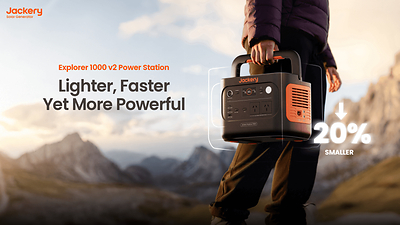
The Explorer 1000 v2 is a strong candidate for readers who want around 1kWh of capacity without a particularly heavy chassis. Jackery lists 1,070Wh, 1,500W rated AC output, 3,000W surge, three AC outlets and two USB-C outputs rated up to 100W and 30W. The unit weighs about 23.8 lb.
Jackery specifies LiFePO4 cells and a 4,000-cycle claim to 70%+ remaining capacity. The product page lists up to 400W through its DC input and around 1.7 hours for standard AC charging, while faster emergency charging is marketed as a separate mode.
Tradeoff: its 1,500W continuous output is lower than the 1,800W output of several competing ~1kWh models here, although its weight is also lower than most of them.
Related guide: 1,000W portable power stations
higher-output 2kWh use
Jackery Explorer 2000 v2
Capacity
2,042Wh
Continuous AC
2,200W
Weight
39.5 lb
Solar input
up to 400W
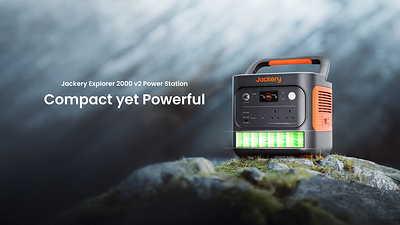
The Explorer 2000 v2 moves into a very different class. Jackery lists 2,042Wh, 2,200W rated output and 4,400W surge, with three AC outlets and a weight of about 39.5 lb.
The manufacturer lists LiFePO4 cells, 4,000 cycles to 70%+ capacity, up to 400W through the DC/solar input and around 2 hours for standard AC charging. Jackery also states a switchover time under 20ms for backup use.
Tradeoff: it provides substantially more output than the S2000, but it is also heavier.
Related guide: home-backup portable power stations
compact travel and light-duty use
Anker SOLIX C300
Capacity
288Wh
Continuous AC
300W
Weight
9.1 lb
Solar input
up to 100W
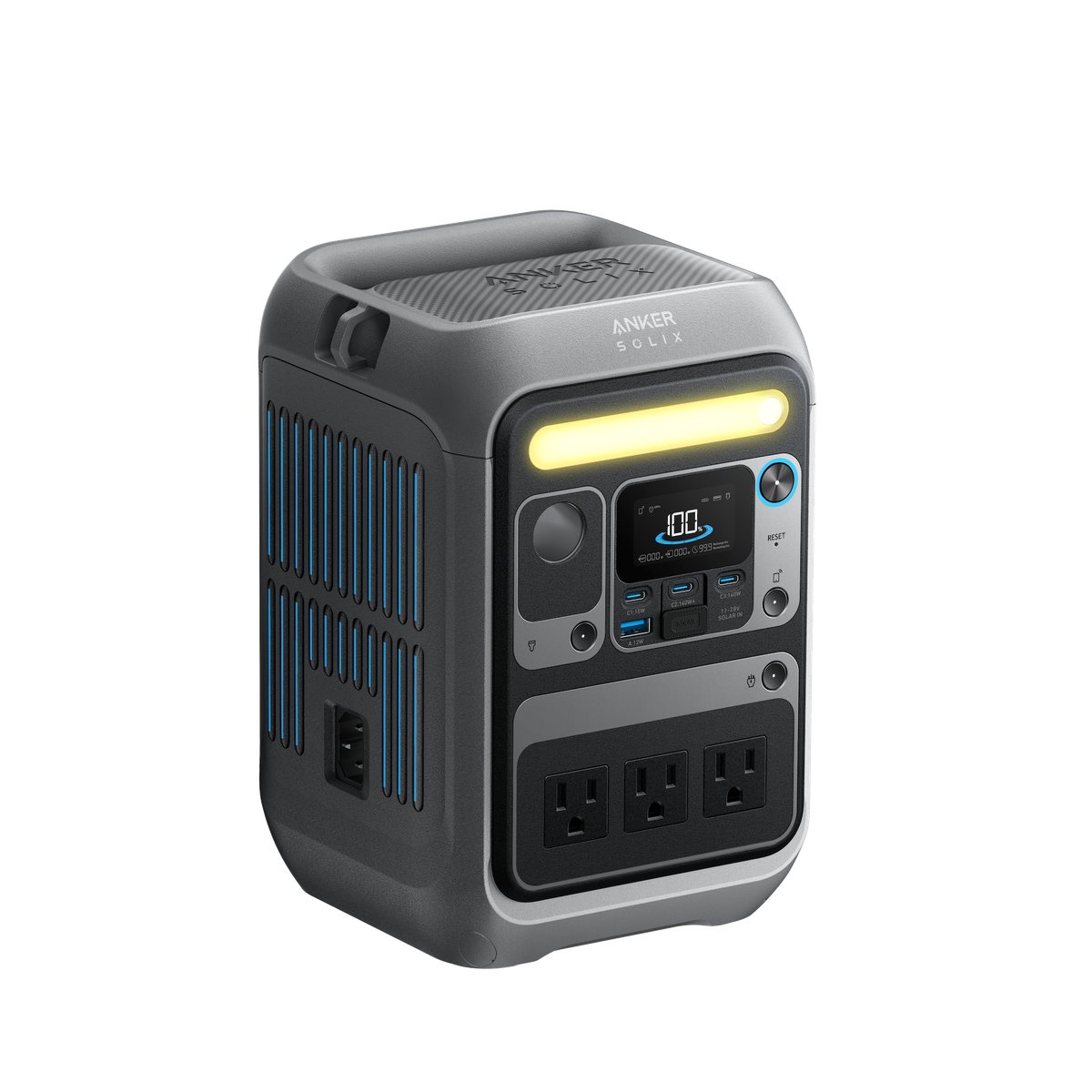
The C300 is the compact outlier in this group. Anker lists 288Wh, 300W AC output, a manufacturer-claimed 600W surge mode, up to 100W solar input, and a weight of 9.1 lb.
It has three AC outlets and high-power USB-C capability, including two ports that can reach 140W under the manufacturer specification. Anker also advertises 80% wall charging in about 50 minutes and backup switching in under 10ms.
Tradeoff: 288Wh is a compact battery, so this is not the product to compare directly with 1–2kWh units for long-duration outage support.
Related guide: portable power stations for camping
solar-heavy ~1kWh use
BLUETTI Elite 100 V2
Capacity
1,024Wh
Continuous AC
1,800W
Weight
about 25 lb
Solar input
up to 1,000W
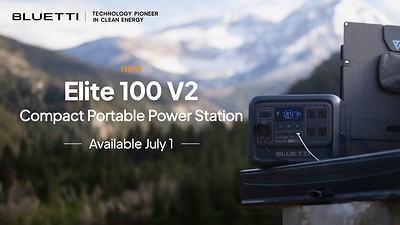
The Elite 100 V2 is one of the more interesting ~1kWh products for readers who care about solar charging. BLUETTI lists 1,024Wh, 1,800W AC output, up to 1,000W solar input, four US AC outlets and a weight of about 25 lb.
BLUETTI also lists Wi-Fi and Bluetooth, a UPS switching time of 10ms or less, and a five-year warranty. Its official product material lists a 4,000+ cycle claim to 80% original capacity.
Tradeoff: manufacturer modes such as Power Lifting need to be treated separately from ordinary continuous-output ratings. The 1,800W continuous figure is the correct baseline for direct comparison.
Related guides: portable power stations for camping and 1,000W portable power stations
lighter 2kWh-class backup
Anker SOLIX S2000
Capacity
2,010Wh
Continuous AC
1,500W
Weight
35.7 lb
Solar input
up to 400W
The S2000 is a 2kWh-class unit that emphasizes a relatively compact chassis. Anker lists 2,010Wh, 1,500W continuous AC output, 3,000W peak, a weight of 35.7 lb, five AC outlets and up to 400W solar input.
Anker’s current specification also lists a UPS switchover of 10ms or less and a five-year warranty. Default AC charging is listed at up to 1,150W, while a higher 1,600W UltraFast mode is available through the app; Anker states roughly 2.3 hours for a full charge in the default mode.
Tradeoff: compared with the Jackery Explorer 2000 v2, the S2000 is lighter but has lower continuous AC output.
Related guide: home-backup portable power stations
connected ~1kWh backup
EcoFlow DELTA 3 Classic

Capacity
1,024Wh
Continuous AC
1,800W
Weight
about 26.7 lb
Solar input
up to 500W
EcoFlow lists the DELTA 3 Classic at 1,024Wh, 1,800W AC output, 3,600W surge, six AC outlets and a weight of about 26.7 lb. The manufacturer also lists X-Boost support up to 2,600W, but X-Boost should not be treated as equivalent to ordinary continuous or surge output.
The unit supports up to 500W PV input, has two USB-C outputs rated up to 100W and 30W, and uses LFP cells. EcoFlow lists 10ms UPS switching and a five-year warranty structure consisting of three years plus two additional years with app registration.
Tradeoff: EcoFlow’s feature set is broad, but buyers who prioritize the highest possible solar-input ceiling in the ~1kWh class should compare it directly with the BLUETTI Elite 100 V2.
Related guide: EcoFlow portable power stations
higher-output ~1kWh general use
Anker SOLIX C1000 Gen 2
Capacity
1,024Wh
Continuous AC
2,000W
Weight
24.9 lb
Solar input
up to 600W
The C1000 Gen 2 is a higher-output ~1kWh option with 1,024Wh, 2,000W continuous AC output and a manufacturer-listed 3,000W peak. Anker lists up to 600W solar input, a weight of 24.9 lb, and 10 ports across its AC, USB and DC connections.
Anker lists a 10ms UPS switchover, a five-year warranty, and an UltraFast charging mode that can fully recharge the station in about 49 minutes under the manufacturer’s stated conditions.
Tradeoff: this generation gives up a small amount of battery capacity versus the original C1000, but it is lighter and raises ordinary AC output from 1,800W to 2,000W.
Related guide: 1,000W portable power stations
established higher-capacity ~1kWh use
BLUETTI AC180

Capacity
1,152Wh
Continuous AC
1,800W
Weight
35.3 lb
Solar input
up to 500W
The AC180 remains a useful established comparator in the ~1kWh class. BLUETTI lists 1,152Wh, 1,800W AC output, up to 500W solar input, four AC outlets and a weight of 35.3 lb.
The official product page lists LiFePO4 cells with a 3,500+ cycle claim, Bluetooth app support and a five-year warranty. BLUETTI states 80% charging in about 45 minutes under its manufacturer-rated conditions.
Tradeoff: at 35.3 lb, it is materially heavier than several newer ~1kWh alternatives, so portability is less of a strength.
Related guides: 1,000W portable power stations, home-backup portable power stations, and best power stations for refrigerator backup
How we compared these products
We did not create a single weighted “best” score, because the right product depends on the job you need it to do.
Technical specifications come from official manufacturer product pages, support pages or manuals for the US market. These cover capacity, battery chemistry, rated output, charging, solar input, ports, dimensions, weight, backup switching and warranty. Manufacturer figures are claims made under stated conditions, so we note where a number depends on a particular mode.
Detailed camping, home-backup and capacity-specific questions are covered in their own guides, linked throughout this page, so this article stays focused on the broad comparison.
Choosing a portable power station by capacity
Under about 500Wh
This class works best when portability matters more than long runtime. It is generally aimed at phones, laptops, lights, cameras, small electronics and other modest loads. The Anker C300 is the only product in this comparison deliberately representing that compact tier.
Around 1kWh
This is the most crowded class in the guide. It offers enough capacity and inverter output to support a much wider set of devices while remaining reasonably portable. Differences in weight, solar input, USB-C output and UPS behavior become especially important because the headline capacities are similar.
For a deeper capacity-specific comparison, see our 1,000W portable power stations guide.
Around 2kWh
A 2kWh-class station provides much more energy storage, but weight and cost rise accordingly. The Jackery Explorer 2000 v2 and Anker S2000 illustrate the tradeoff clearly: one offers higher continuous AC output, while the other is lighter.
Choosing by use case
If your main goal is camping, weight, charging flexibility and the loads you actually carry matter more than simply buying the largest battery. See our portable power stations for camping guide.
For home backup, start with the appliances you need to keep running, their startup behavior, and the outage duration you are planning for. Our home-backup portable power station guide covers that search task in more depth.
RV users should also consider how the station will be charged while traveling and what continuous loads will run at the same time.
Device-specific questions, such as refrigerators, furnaces and CPAP machines, need more careful runtime and startup analysis than a general best-of article can provide.
What specifications matter most?
Watt-hours and watts are not the same thing
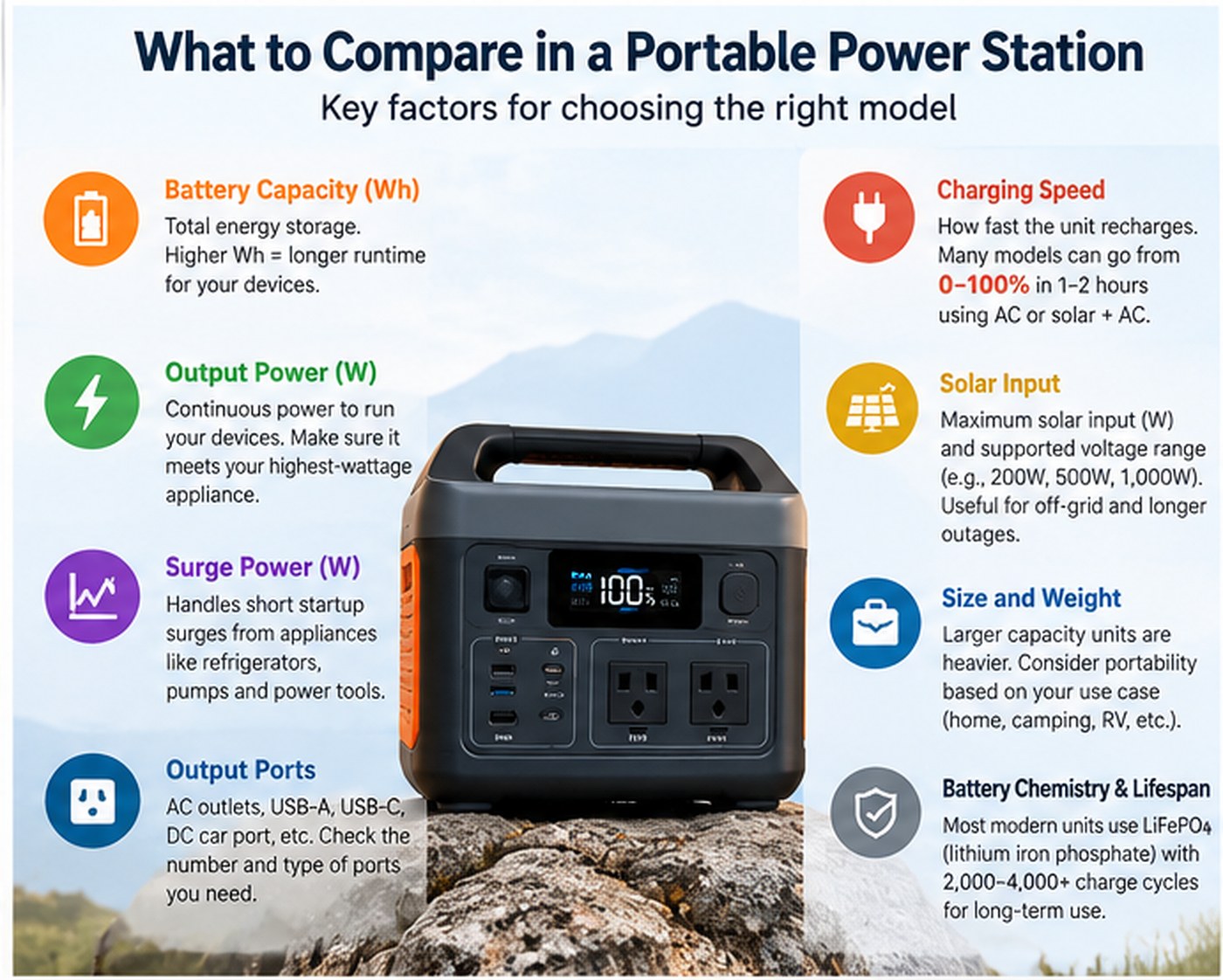
Watt-hours (Wh) describe stored energy. Watts (W) describe how much power a unit can deliver at a moment in time. A larger Wh figure can increase runtime, but only if the inverter can also support the device you want to run.
Continuous output matters more than marketing modes
Use the continuous AC rating as the starting point. Surge ratings and manufacturer modes such as SurgePad, Power Lifting and X-Boost can be useful, but they work differently and should not be treated as identical specifications.
Solar input can matter as much as battery capacity
For off-grid use, a high solar-input ceiling can shorten recovery time when compatible panels and good sunlight are available. The actual charging rate depends on panel configuration, conditions and input limits.
Fast wall charging is useful, but read the conditions
Manufacturers often quote charging times under specific high-power or app-enabled modes. Those figures are useful for comparison, but real-world charging can vary with temperature, power source, settings and battery state.
UPS/EPS switching is not the same as a dedicated zero-transfer UPS
A 10–20ms switchover can be suitable for many electronics, but it does not guarantee interruption-free operation for every device. Check the manufacturer guidance for critical equipment.
Weight changes the meaning of “portable”
A 9 lb station and a 39 lb station can both be portable, but they are portable in very different ways. Match the capacity class to how often you expect to move the unit.
FAQ
Is a portable power station worth it?
It can be if you need quiet battery power for camping, short outages, electronics, remote work or devices that do not justify running a fuel generator. The value depends on how often you will use it, the loads you need to support and whether the battery size matches those loads.
How long will a portable power station run a refrigerator?
There is no reliable one-size-fits-all answer. Refrigerator power draw cycles on and off, startup demand varies, and inverter losses reduce usable energy. Use the refrigerator’s actual energy consumption where possible and leave a margin rather than dividing battery Wh by a single wattage number. See our home-backup guide for a more detailed approach.
What will a 1,000W power station run?
A 1,000W inverter can generally support loads whose continuous demand stays within its rated limit, but startup surges and simultaneous loads also matter. The battery’s Wh capacity then determines how long those loads can run. Our 1,000W guide separates inverter output from battery capacity.
Can I leave a portable power station plugged in all the time?
That depends on the model and the manufacturer’s UPS/bypass guidance. Some products are designed for standby backup use, while others have specific storage or state-of-charge recommendations. Follow the exact manual for your model rather than assuming all power stations behave the same way.
What are the downsides of portable power stations?
The main tradeoffs are price, weight, finite battery capacity and recharge time. Solar charging depends on weather and panel setup, batteries gradually age, and high-power appliances can exceed inverter limits. A larger station can solve some runtime problems, but it becomes heavier and more expensive.
Choose for the job
The useful way to shop for a portable power station is to start with the job, not the brand name.
Choose a compact unit when portability dominates. Choose a ~1kWh model when you want a balance of runtime and mobility. Move to a 2kWh-class product when outage support or larger loads matter enough to justify extra weight.
The eight products here cover those different jobs rather than representing a single linear ranking. Before buying, check current availability and price on Amazon, and confirm that the exact model and version still match the specifications listed here.
Sources
Technical specifications come from current official manufacturer pages and support documentation:
- Jackery Explorer 1000 v2 , https://www.jackery.com/products/jackery-explorer-1000-v2
- Jackery Explorer 2000 v2 , https://www.jackery.com/products/jackery-explorer-2000-v2-portable-power-station
- Anker SOLIX C300 , https://support.ankersolix.com/s/product/a08J1000000Y3w4IAC/anker-solix-c300-portable-power-station and https://www.ankersolix.com/products/c300
- BLUETTI Elite 100 V2 , https://www.bluettipower.com/products/elite-100-v2-portable-power-station
- Anker SOLIX S2000 , https://www.ankersolix.com/s2000
- EcoFlow DELTA 3 Classic , https://www.ecoflow.com/us/delta-3-classic-portable-power-station
- Anker SOLIX C1000 Gen 2, https://www.ankersolix.com/products/c1000-gen2
- BLUETTI AC180 , https://www.bluettipower.com/products/ac180