
As an Amazon Associate I earn from qualifying purchases.
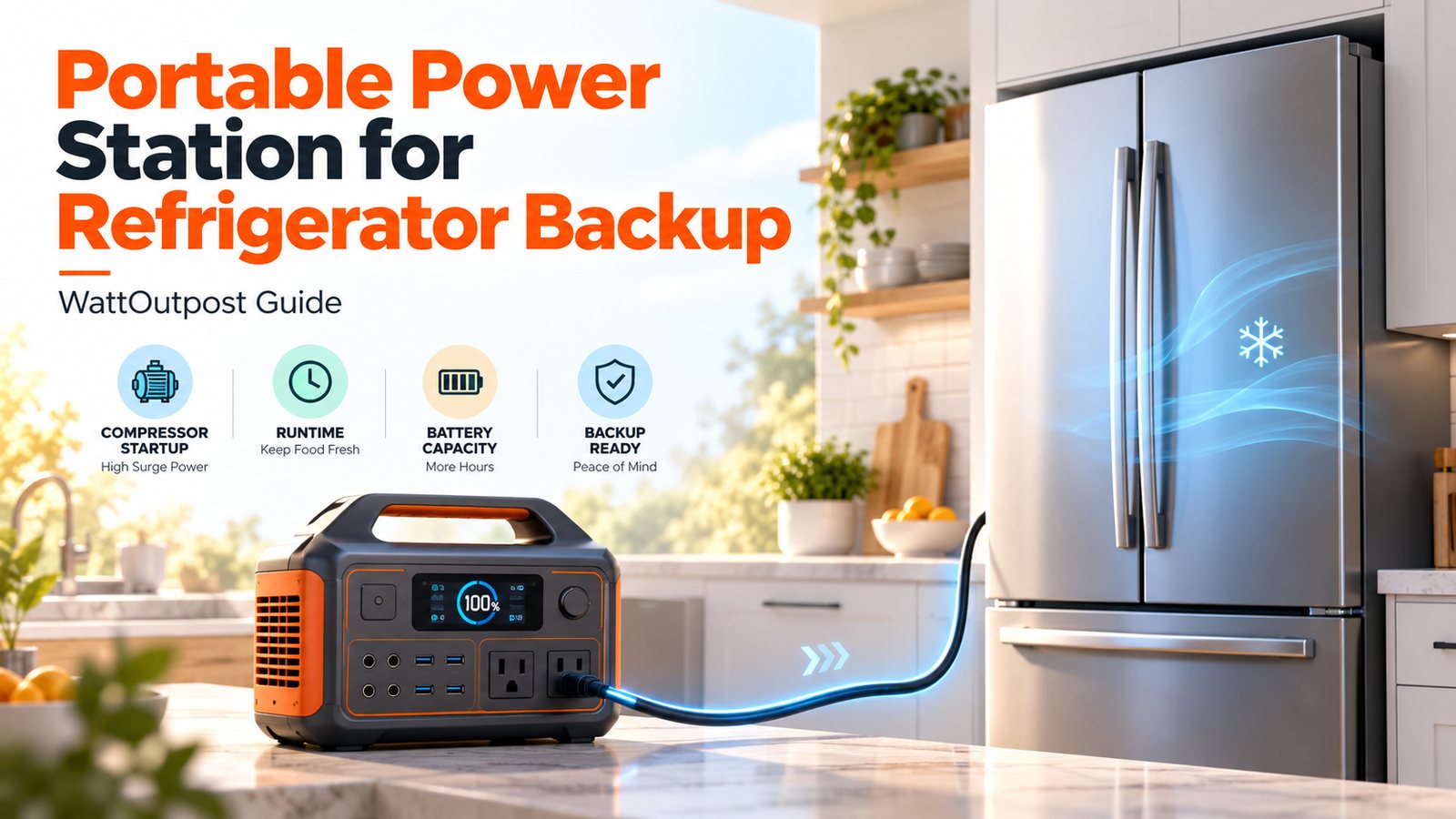
The best portable power station for refrigerator backup needs to do two jobs well: start the compressor without tripping and store enough energy to keep the refrigerator cycling through the outage. For most homes, a 1kWh unit is the practical overnight class; a 2kWh unit is the stronger choice for longer outages; and an expandable 3.5kWh+ system makes sense when you also need a freezer or other essential loads.
Last updated October 6, 2026. See our editorial and research methodology.
This guide compares seven refrigerator-ready power stations using current manufacturer specifications, live Amazon product-identity checks, and transparent runtime calculations. We do not claim hands-on laboratory testing. Every runtime estimate below can be checked with the same formula we use.
Quick picks: best portable power stations for refrigerator backup
- Best overall: Anker SOLIX C2000 Gen 2 — 2,048Wh, 2,400W continuous output, 4,000W peak, 10ms UPS, and expansion support.
- Best refrigerator-first 2kWh option: Anker SOLIX S2000 — 2,010Wh, 1,500W output and manufacturer-published refrigerator-backup positioning with sub-10ms UPS.
- Best lightweight 1kWh option: Jackery Explorer 1000 v2 — 1,070Wh, 1,500W output, 3,000W surge peak, about 23.8 lb.
- Best 1kWh startup headroom: BLUETTI Elite 100 V2 — 1,024Wh, 1,800W continuous output, 3,600W surge and 10ms UPS.
- Best fast-transfer 1kWh option: EcoFlow DELTA 3 Classic — 1,024Wh, 1,800W output and 10ms auto-switch.
- Best compact 2kWh long-runtime option: Jackery Explorer 2000 v2 — 2,042Wh, 2,200W output and 4,400W instantaneous output.
- Best multi-day expandable option: Jackery HomePower 3600 Plus — 3,584Wh, 3,600W output and expansion to about 21.5kWh per unit.
Refrigerator backup power stations compared
Runtime uses: capacity × 0.85 ÷ 120W. It is a planning estimate, not a tested guarantee.
Anker SOLIX C2000 Gen 2
Best overall
Capacity
2,048Wh
Continuous AC
2,400W
Peak / surge
4,000W peak
UPS / transfer
10ms
Calculated runtime at 120W avg.
~14.5 h
Anker SOLIX S2000
Refrigerator-first 2kWh
Capacity
2,010Wh
Continuous AC
1,500W
Peak / surge
3,000W peak
UPS / transfer
<10ms
Calculated runtime at 120W avg.
~14.2 h
Jackery Explorer 1000 v2
Lightweight 1kWh
Capacity
1,070Wh
Continuous AC
1,500W
Peak / surge
3,000W surge peak
UPS / transfer
Check current manual for your use case
Calculated runtime at 120W avg.
~7.6 h
BLUETTI Elite 100 V2
1kWh startup headroom
Capacity
1,024Wh
Continuous AC
1,800W
Peak / surge
3,600W surge
UPS / transfer
10ms
Calculated runtime at 120W avg.
~7.3 h
EcoFlow DELTA 3 Classic
Fast-transfer 1kWh
Capacity
1,024Wh
Continuous AC
1,800W
Peak / surge
3,600W surge
UPS / transfer
10ms
Calculated runtime at 120W avg.
~7.3 h
Jackery Explorer 2000 v2
Compact 2kWh runtime
Capacity
2,042Wh
Continuous AC
2,200W
Peak / surge
4,400W instantaneous
UPS / transfer
20ms
Calculated runtime at 120W avg.
~14.5 h
Jackery HomePower 3600 Plus
Multi-day / expandable
Capacity
3,584Wh
Continuous AC
3,600W
Peak / surge
7,200W instantaneous
UPS / transfer
<10ms
Calculated runtime at 120W avg.
~25.4 h
View the full comparison table
| Model | Best for | Capacity | Continuous AC | Peak / surge | UPS / transfer | Calculated runtime at 120W avg. |
|---|---|---|---|---|---|---|
| Anker SOLIX C2000 Gen 2 | Best overall | 2,048Wh | 2,400W | 4,000W peak | 10ms | ~14.5 h |
| Anker SOLIX S2000 | Refrigerator-first 2kWh | 2,010Wh | 1,500W | 3,000W peak | <10ms | ~14.2 h |
| Jackery Explorer 1000 v2 | Lightweight 1kWh | 1,070Wh | 1,500W | 3,000W surge peak | Check current manual for your use case | ~7.6 h |
| BLUETTI Elite 100 V2 | 1kWh startup headroom | 1,024Wh | 1,800W | 3,600W surge | 10ms | ~7.3 h |
| EcoFlow DELTA 3 Classic | Fast-transfer 1kWh | 1,024Wh | 1,800W | 3,600W surge | 10ms | ~7.3 h |
| Jackery Explorer 2000 v2 | Compact 2kWh runtime | 2,042Wh | 2,200W | 4,400W instantaneous | 20ms | ~14.5 h |
| Jackery HomePower 3600 Plus | Multi-day / expandable | 3,584Wh | 3,600W | 7,200W instantaneous | <10ms | ~25.4 h |
Why no prices in the table? Amazon and manufacturer prices can change quickly. WattOutpost verifies the exact product identity and sends you to the current listing rather than hard-coding a price that may be wrong later.
How long will a portable power station run a refrigerator?
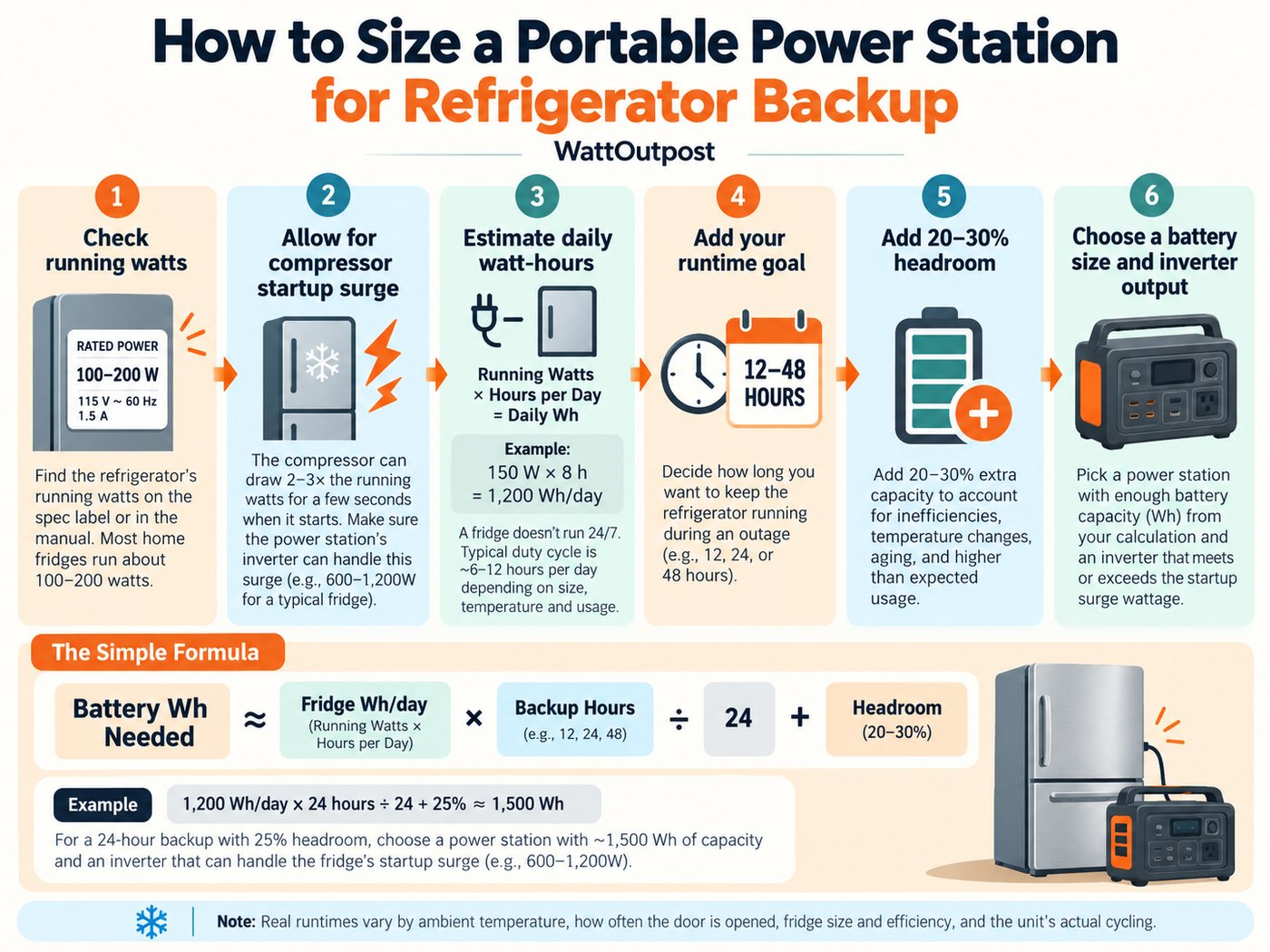
Runtime depends on the refrigerator’s average power draw, not just the wattage you see while the compressor is running. A refrigerator cycles: the compressor starts, runs, switches off, then starts again later. Room temperature, door openings, defrost cycles and appliance age all change the average.
For planning, we use this transparent estimate:
Estimated AC runtime (hours) = battery capacity (Wh) × 0.85 ÷ average refrigerator draw (W)
The 0.85 factor is a conservative allowance for inverter and system losses, not a manufacturer guarantee.
Runtime matrix: efficient fridge, busy fridge, and fridge + freezer
| Model | Efficient fridge 60W avg. | Typical/busier fridge 120W avg. | Fridge + freezer 180W avg. |
|---|---|---|---|
| Anker SOLIX C2000 Gen 2 — 2,048Wh | ~29.0 h | ~14.5 h | ~9.7 h |
| Anker SOLIX S2000 — 2,010Wh | ~28.5 h | ~14.2 h | ~9.5 h |
| Jackery Explorer 1000 v2 — 1,070Wh | ~15.2 h | ~7.6 h | ~5.1 h |
| BLUETTI Elite 100 V2 — 1,024Wh | ~14.5 h | ~7.3 h | ~4.8 h |
| EcoFlow DELTA 3 Classic — 1,024Wh | ~14.5 h | ~7.3 h | ~4.8 h |
| Jackery Explorer 2000 v2 — 2,042Wh | ~28.9 h | ~14.5 h | ~9.6 h |
| Jackery HomePower 3600 Plus — 3,584Wh | ~50.8 h | ~25.4 h | ~16.9 h |
Use your EnergyGuide label to estimate average watts
If your refrigerator’s yellow EnergyGuide label shows estimated annual energy use in kWh, you can convert it to average watts:
Annual kWh ÷ 8.76 ≈ average watts
Example: a refrigerator rated at 500 kWh/year averages about 57W across the year. That does not tell you compressor startup power, but it gives you a much better runtime input than assuming every refrigerator uses the same wattage.
Refrigerator backup runtime calculator
Enter the battery capacity and your refrigerator’s measured or estimated average draw. The calculator uses the same 85% usable-energy assumption as the tables above.
Estimated AC runtime: 14.5 hours
Planning estimate only. Actual runtime varies with inverter losses, temperature, compressor cycling, door openings and battery reserve.
What size power station do you need for a refrigerator?
Mini fridge or efficient modern refrigerator
A 1kWh station is usually the most practical starting class once you have confirmed compressor startup compatibility. It gives materially more runtime margin than a small 200–500Wh unit while remaining easy to move.
Full-size refrigerator for an overnight outage
Start around 1,000–1,200Wh with at least 1,500W continuous AC output. Our 120W planning scenario gives roughly 7–8 hours from the 1kWh picks before real-world variation.
Full-size refrigerator for a longer outage
The 2kWh class is the stronger target. Under the same 120W planning assumption, the C2000 Gen 2, S2000 and Explorer 2000 v2 calculate to roughly 14–15 hours before real-world variation.
Refrigerator plus freezer or multi-day outages
Move toward 3.5kWh or an expandable platform. A refrigerator plus a freezer increases average demand, and multi-day outages add the need for solar, vehicle charging or external batteries. See our high-capacity portable power station guide for the larger class.
Mini fridge vs full-size refrigerator: do you need the same battery size?
No. Refrigerator type matters, but model-to-model variation is large enough that cabinet size alone should not determine your purchase. A compact mini fridge may use substantially less energy than a large household refrigerator, while a modern variable-speed compressor can behave differently from an older fixed-speed design. The safest approach is still to measure your appliance or use its EnergyGuide annual-energy figure for runtime planning.
Portable power station for a mini fridge
If you are specifically shopping for a portable power station for a mini fridge, the 1kWh recommendations on this page may provide more runtime than you need. That extra margin can still be useful during outages because it reduces recharge frequency and leaves capacity for phones, lights or a router. The important check is still compressor startup: do not size the inverter only from average energy use.
Full-size or side-by-side refrigerator
A 1kWh station is the practical starting class for many full-size refrigerators when the inverter rating and compressor startup are compatible. The 2kWh class is more comfortable when you want the refrigerator to run through a longer overnight outage without immediately planning a recharge. Large side-by-side units, older refrigerators, warm garages and frequent door openings can all push energy use upward.
Refrigerator plus freezer
Two compressor appliances change the problem. Their average energy demand is higher and their startup events can occur at different times—or occasionally overlap. For a refrigerator plus freezer, we prefer the 2kWh or larger recommendations and would measure both appliances before relying on the system in an extended outage.
UPS and transfer time: useful, but not the same as refrigerator runtime
A UPS-capable power station can remain connected between the wall and refrigerator and switch to battery when utility power disappears. That is convenient because backup begins without moving plugs during a storm. It does not increase battery capacity, and a faster transfer time does not make a 1kWh station run as long as a 2kWh station.
For this guide, we treat UPS/EPS behavior as a convenience and continuity feature after basic electrical compatibility is established. The C2000 Gen 2 and Elite 100 V2 publish 10ms transfer figures; the S2000 and HomePower 3600 Plus publish sub-10ms figures; EcoFlow lists 10ms auto-switching for the DELTA 3 Classic; and Jackery lists 20ms for the Explorer 2000 v2. Always follow the refrigerator manufacturer’s guidance on restart delays and avoid repeatedly switching a compressor off and back on within a few seconds.
Why refrigerator startup surge matters
The compressor can briefly draw much more power when it starts than while it is already running. This short spike is why a battery may contain enough energy but still fail to start a refrigerator: the inverter overloads before battery capacity becomes relevant.
Use the refrigerator nameplate and manual as a starting point, and measure actual behavior if possible. A plug-in power meter that records energy over time is especially useful. Do not assume that a manufacturer-specific boost mode works the same way as a conventional compressor surge rating.
#1 Anker SOLIX C2000 Gen 2 — best overall
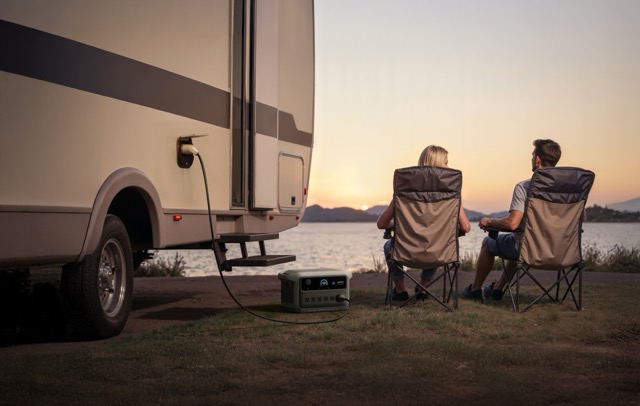
The Anker SOLIX C2000 Gen 2 combines 2,048Wh of battery capacity with 2,400W continuous output, 4,000W peak power and a manufacturer-listed 10ms UPS transfer. Anker also supports expansion with the BP2000 Gen 2 battery.
Why it ranks first here: the 2kWh battery is a meaningful step up from the 1kWh class, the inverter has abundant compressor-starting headroom, and the expansion path makes it useful beyond a single refrigerator. At 120W average refrigerator draw, our planning formula gives about 14.5 hours.
C2000 Gen 2 pros and limitations
- Pros: 2,048Wh battery; 2,400W continuous output; 4,000W peak; 10ms UPS; expandable.
- Limitations: around 41.7 lb; larger and heavier than the 1kWh picks.
#2 Anker SOLIX S2000 — best refrigerator-first 2kWh option
Anker lists the SOLIX S2000 at 2,010Wh and 1,500W continuous output. The manufacturer specifically positions it around refrigerator backup, advertises sub-10ms UPS switching, and publishes low-idle-power claims aimed at loads that cycle on and off.
Our conservative calculation is about 14.2 hours at a 120W average and about 28.5 hours at 60W average. Those figures are our calculations, not Anker’s advertised runtime.
S2000 pros and limitations
- Pros: 2,010Wh; refrigerator-focused design; sub-10ms UPS; about 35.7 lb.
- Limitations: 1,500W continuous output is lower than the other 2kWh picks; no expansion path is the main tradeoff.
#3 Jackery Explorer 1000 v2 — best lightweight 1kWh option
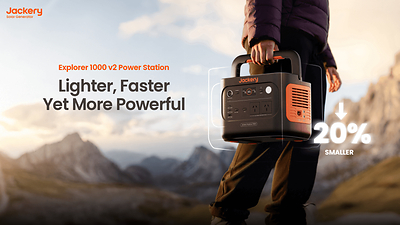
Jackery lists the Explorer 1000 v2 at 1,070Wh, 1,500W rated AC output and a 3,000W surge peak. At about 23.8 lb, it is the lightest of our seven picks.
That makes it appealing when refrigerator backup must stay genuinely portable. Under our 120W scenario it calculates to about 7.6 hours; at 60W average, about 15.2 hours.
Explorer 1000 v2 pros and limitations
- Pros: lowest weight here; 1,070Wh; 3,000W surge peak; simple self-contained design.
- Limitations: 1kWh-class runtime; not our first choice if you also need a freezer.
#4 BLUETTI Elite 100 V2 — best 1kWh startup headroom
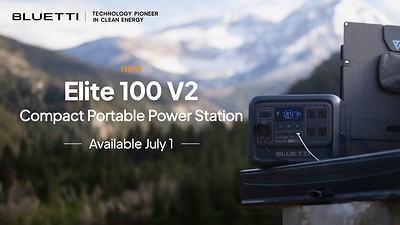
BLUETTI lists the Elite 100 V2 with 1,024Wh, 1,800W continuous output, 3,600W surge and 10ms UPS response. That is substantial inverter headroom for a compact 1kWh-class station.
At a 120W average refrigerator draw, our estimate is about 7.3 hours. At a 60W average, about 14.5 hours.
Elite 100 V2 pros and limitations
- Pros: 1,800W continuous; 3,600W surge; 10ms UPS; compact 1kWh class.
- Limitations: shorter runtime than 2kWh options; measure your refrigerator if the outage target is overnight or longer.
#5 EcoFlow DELTA 3 Classic — best fast-transfer 1kWh option

EcoFlow lists the DELTA 3 Classic at 1,024Wh with 1,800W output and a 10ms auto-switch. EcoFlow’s regional specifications also list 3,600W surge output.
It calculates to the same basic runtime as the BLUETTI because both store 1,024Wh: about 7.3 hours at 120W average. Its main refrigerator-backup distinction is the fast-transfer feature rather than extra battery capacity.
DELTA 3 Classic pros and limitations
- Pros: 1,800W output; 10ms auto-switch; strong 1kWh-class refrigerator compatibility.
- Limitations: 1,024Wh remains an overnight-class battery for many refrigerator loads.
#6 Jackery Explorer 2000 v2 — best compact 2kWh long-runtime option
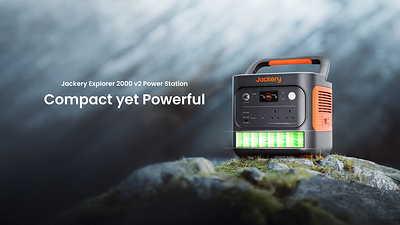
The Explorer 2000 v2 combines 2,042Wh with 2,200W continuous output and 4,400W maximum instantaneous output. Jackery lists it at about 39.5 lb with 20ms UPS switching.
For refrigerator use, the main reason to choose it over a 1kWh station is stored energy: about 14.5 hours in our 120W scenario and 28.9 hours at 60W average.
Explorer 2000 v2 pros and limitations
- Pros: 2,042Wh; 2,200W output; 4,400W instantaneous output; relatively compact for 2kWh.
- Limitations: 20ms transfer is slower than the 10ms-class options; no expansion battery path.
#7 Jackery HomePower 3600 Plus — best multi-day expandable option

Jackery lists the HomePower 3600 Plus at 3,584Wh and 3,600W output, with 7,200W maximum instantaneous output. It supports up to five compatible battery packs for about 21.5kWh per unit, and Jackery publishes a sub-10ms UPS transfer.
Even before expansion, our 120W scenario calculates to about 25.4 hours. At 60W average, about 50.8 hours. This is the strongest option here for a refrigerator plus other essential loads or for an outage plan that may grow beyond one battery.
HomePower 3600 Plus pros and limitations
- Pros: 3,584Wh base; 3,600W output; expandable to about 21.5kWh; sub-10ms UPS.
- Limitations: around 77 lb; much larger than a carryable 1kWh station and unnecessary for short outages.
How to set up a power station for refrigerator backup
- Confirm the refrigerator load first. Check the nameplate/manual and measure actual energy use if possible.
- Charge the station before severe weather. A refrigerator backup is only useful if the battery is ready when the grid fails.
- Use a direct connection where practical. Plug the refrigerator into the station or use an electrical backup arrangement approved for the installation.
- Do not backfeed household wiring. Never improvise a male-to-male cord or energize a circuit from a receptacle.
- Keep refrigerator and freezer doors closed. Lower thermal load means less compressor runtime.
- Plan the recharge path. For long outages consider compatible solar, vehicle charging or a larger/expandable battery system.
How to recharge during a long refrigerator outage
Once an outage extends beyond the first battery cycle, recharge strategy can matter as much as initial capacity. If grid power returns briefly, fast AC charging can restore a meaningful amount of energy before the next interruption. Compatible solar can stretch runtime during daylight, while vehicle charging may provide another option when driving is practical and safe.
Do not assume the largest advertised solar-input number will be available in every condition. Solar output depends on panel size, sun angle, weather, temperature and the station’s input limits. For multi-day refrigerator backup, think in terms of an energy budget: energy consumed by the refrigerator each day versus energy you can realistically put back into the battery.
Food safety during a refrigerator power outage
Battery runtime and food safety are separate questions. The U.S. Department of Agriculture says an unopened refrigerator keeps food safely cold for about four hours after power is lost. A full freezer can hold its temperature for about 48 hours, or about 24 hours if half full, when the door remains closed.
A power station can extend refrigeration time, but restoring electricity does not automatically make food safe if it has already spent too long above a safe temperature. Follow USDA guidance rather than relying on smell or appearance.
Portable power station vs gas generator for a refrigerator
| Factor | Portable power station | Gas generator |
|---|---|---|
| Indoor operation | No combustion exhaust; follow product ventilation instructions | Never operate indoors because of carbon-monoxide risk |
| Automatic transfer | Available on selected UPS/EPS-capable models | Usually requires a different transfer/setup approach |
| Noise | Generally low | Engine noise |
| Runtime extension | Recharge from grid, compatible solar, vehicle or expansion battery | Refuel when safely operated outdoors |
| Best fit | Short-to-medium outages, indoor appliance backup, low maintenance | Long outages when fuel storage and safe outdoor operation are available |
How we picked these seven refrigerator-backup stations
We did not rank these products by Amazon star rating, sales rank or a hidden affiliate payout. The shortlist was built around refrigerator-backup requirements:
- Output headroom: at least 1,500W ordinary AC output for the selected recommendations.
- Battery capacity: useful 1kWh, 2kWh and 3.5kWh+ tiers rather than tiny batteries with limited outage runtime.
- Startup / peak capability: enough published headroom to reduce compressor-start risk when the refrigerator itself is compatible.
- UPS/EPS behavior: considered where manufacturers publish a transfer specification.
- Portability: weight and physical class matter because “portable” ranges from carryable to wheeled.
- Expansion and recharge: important for multi-day outages.
- Source quality: specifications checked against current manufacturer material, and Amazon ASIN identity verified separately before affiliate links were published.
We deliberately do not claim lab-tested refrigerator runtime. The runtime table is calculated from published battery capacity using a stated 85% planning factor so you can substitute your own measured refrigerator draw.
Frequently asked questions
What is the best portable power station for a refrigerator?
For the broadest balance of runtime, inverter headroom, UPS transfer and expansion, our current best overall pick is the Anker SOLIX C2000 Gen 2. If low weight matters more, the Jackery Explorer 1000 v2 is much easier to move. If the priority is multi-day expandable backup, the Jackery HomePower 3600 Plus is the stronger class.
Can a 1,000Wh power station run a refrigerator?
Yes, when the inverter can handle both normal running load and compressor startup. Runtime depends on the refrigerator’s average power use. At a 120W planning average, a 1,024Wh station works out to roughly 7.3 hours using our 85% usable-energy assumption.
How long will a 2,000Wh power station run a refrigerator?
At 120W average draw, a 2,000Wh-class station works out to roughly 14 hours under our formula. At 60W average, it approaches 28 hours. Real runtime can differ substantially, so use your own measured or EnergyGuide-derived average draw.
What size battery backup do I need for a refrigerator and freezer?
Measure the combined average energy use and confirm startup compatibility for both compressors. A 2kWh station gives more useful margin than 1kWh, while a 3.5kWh+ or expandable system is better suited to long outages or multiple cold-storage appliances.
What is the best battery backup for a refrigerator?
The best battery backup for a refrigerator is one that combines enough inverter headroom to start the compressor with enough watt-hours for your target outage. For an all-around balance we currently favor the 2,048Wh Anker SOLIX C2000 Gen 2; for lighter carry-around use, a 1kWh model such as the Jackery Explorer 1000 v2 may be more practical; for multi-day expansion, the Jackery HomePower 3600 Plus is in a different class.
Can one portable power station run both a refrigerator and a freezer?
Yes, if the inverter can handle the combined running and startup demands and the battery is large enough for the desired runtime. Our 180W combined-load column is only a planning scenario; two real appliances may average more or less, and their compressors can start independently. Measure both loads for a dependable outage plan.
Does a refrigerator need a pure sine-wave inverter?
For modern household appliances and compressor loads, a quality pure-sine AC output is the prudent choice. The models recommended here are full portable power stations intended for household AC loads; still verify compatibility with your appliance documentation.
Does UPS transfer time matter for a refrigerator?
It matters most if you want the station to sit between the wall and refrigerator and take over automatically. A refrigerator is less interruption-sensitive than a computer, but automatic transfer can make outage backup more convenient. Always follow the refrigerator manufacturer’s restart guidance and avoid rapid repeated power cycling.
How do I calculate refrigerator watts from the EnergyGuide label?
Divide annual energy use in kWh by 8.76 to estimate average watts. For example, 500 kWh/year ÷ 8.76 is about 57W average. This helps with runtime planning but does not replace checking compressor startup demand.
Bottom line
The best refrigerator backup is not automatically the biggest battery. Choose the smallest station that comfortably starts your refrigerator and gives the outage runtime you actually need. For many homes that means a 1kWh station for short or overnight outages, a 2kWh station for substantially longer runtime, or an expandable 3.5kWh+ system when a freezer and other essential loads are part of the plan.
Related WattOutpost guides: portable power stations for home backup, high-capacity portable power stations, 1,000W portable power stations, gas-furnace backup, and our best portable power stations comparison.
Sources
- Anker SOLIX C2000 Gen 2: Anker SOLIX specifications
- Anker SOLIX S2000: Anker SOLIX specifications
- Jackery Explorer 1000 v2: Jackery specifications
- BLUETTI Elite 100 V2: BLUETTI specifications
- EcoFlow DELTA 3 Classic: EcoFlow specifications
- Jackery Explorer 2000 v2: Jackery specifications
- Jackery HomePower 3600 Plus: Jackery specifications
- USDA Food Safety and Inspection Service: food safety during emergencies